





Cemetery Guidelines for Headstones: Placement and Installation


The process of choosing and installing a headstone is a significant milestone in the grieving process. It represents a permanent tribute to a life lived and serves as a focal point for future generations to visit. However, beyond the emotional and aesthetic choices lies a complex world of administrative regulations, engineering requirements, and geological considerations.
Proper installation is the difference between a monument that stands for centuries and one that tilts, cracks, or is forcibly removed due to non-compliance. This article provides an exhaustive look into the guidelines governing headstone placement and the technical rigors of professional installation.
1. Legal and Administrative Framework
Before a single shovel of dirt is moved, you must navigate the legal landscape of the cemetery. It is a common misconception that buying a “plot” means you own the land. In most jurisdictions, you are purchasing the “Grant of Right of Burial,” which is essentially a license to use the space under specific conditions.
The Permit Process
Most cemeteries—whether municipal, religious, or private—require a formal application for a “Monumental Permit.” The following documents are typically required:
-
Deed of Grant: Proof that you are the registered owner of the burial rights.
-
Application Form: A detailed document signed by the owner of the rights and the stonemason.
-
Design Blueprints: Scaled drawings showing the dimensions (height, width, thickness), material type, and the proposed inscription.
-
Contractor Credentials: Proof that the installer has public liability insurance and is registered with the cemetery board.
Administrative Restrictions
Cemeteries are often divided into sections (e.g., Lawn Sections, Monumental Sections, Heritage Sections), each with its own “thematic” rules:
-
Height Restrictions: To maintain a uniform appearance, many cemeteries cap height at 3 or 4 feet.
-
Material Limitations: Some sections may only allow bronze plaques on granite bases, while others may strictly permit only grey or black granite to ensure a somber, uniform aesthetic.
-
Inscription Decorum: While personalization is encouraged, cemetery boards often reserve the right to veto language or imagery deemed offensive or inappropriate for a sacred space.
2. Timing and Environmental Considerations
One of the most critical factors in headstone installation is the “settling” of the earth. When a grave is dug, the soil structure is disrupted. Even with modern mechanical tamping, the ground remains unstable for a significant period.
-
The Twelve-Month Rule: It is standard industry practice to wait at least 6 to 12 months after a burial before installing a heavy monument. This allows for seasonal rains and natural gravity to compact the soil. Installing too early is the leading cause of “leaning” headstones.
-
Seasonal Windows: Installation should ideally take place when the ground is neither frozen nor saturated with water. In colder climates, cemeteries often suspend all installation work between November and April to prevent frost heave from damaging new foundations.
3. Foundation Engineering: The Bedrock of Stability
The foundation is the invisible hero of a headstone. Its job is to distribute the massive weight of the stone (often weighing between 200 and 1,000 pounds) across a wide enough surface area to prevent sinking.
Comparison Table: Foundation Types for Headstones
| Foundation Type | Description | Best Suited For | Expected Longevity | Pro/Con |
| Concrete Pier (Piling) | Deep concrete columns poured down to the “undisturbed” earth. | Heavy upright monuments and unstable, sandy soil. | 75+ Years | Pro: Extremely stable. Con: High labor cost. |
| Ribbon / Beam Foundation | A long continuous concrete strip that supports an entire row of stones. | Standard lawn cemeteries with uniform rows. | 40–60 Years | Pro: Cost-effective. Con: Movement in one stone can affect neighbors. |
| Pre-Cast Concrete Pad | A pre-made concrete slab leveled on a bed of gravel. | Smaller headstones or temporary markers. | 20–30 Years | Pro: Fast installation. Con: Prone to shifting in heavy rain. |
| Monolithic Slab | A large, reinforced concrete floor covering the entire plot. | Full-length kerbed monuments or multi-person plots. | 100+ Years | Pro: Maximum durability. Con: Permanent and very expensive. |

4. Step-by-Step Installation Process
Professional stonemasons follow a strict protocol to ensure the monument remains level and secure.
Phase 1: Site Preparation
The installer begins by clearing the site of grass and debris. Using a transit level or laser level, they determine the exact slope of the ground. It is vital that the foundation is not just level with the ground, but perfectly horizontal regardless of the terrain’s incline.
Phase 2: Excavation and Base Layer
A hole is dug to the required depth (usually 12–24 inches depending on local frost lines). A “sub-base” of compacted crushed stone or gravel is added. This layer is crucial for drainage; it prevents water from pooling under the concrete, which would otherwise lead to cracks during freeze-thaw cycles.
Phase 3: Setting the Base
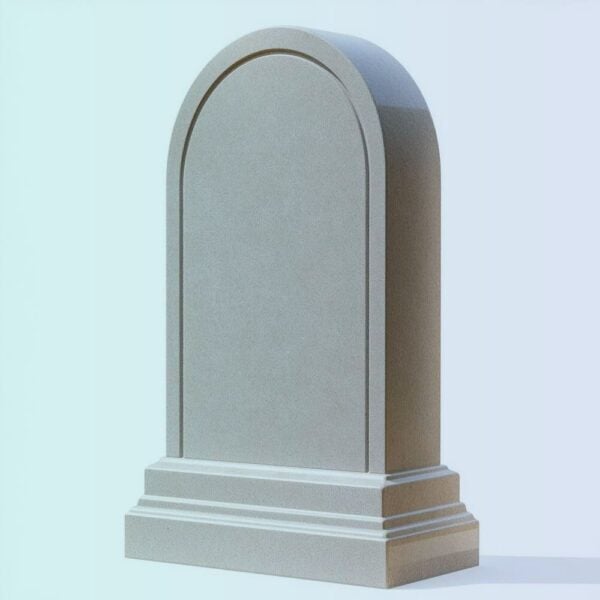
The “Base” is the lower part of the headstone. It is placed onto the wet concrete or a leveled dry-pour mix. Installers use plastic shims to achieve perfect levelness. Once the base is set, the area is backfilled with earth and tamped down.
Phase 4: The Dowel System (Pinning)
A headstone is never simply “glued” to its base. To prevent the “Die” (the upright part) from toppling over, a stainless steel or galvanized steel pin (dowel) is used.
-
A hole is drilled into the center of the base.
-
A matching hole is drilled into the bottom of the upright stone.
-
The pin is inserted with high-strength architectural epoxy or a specialized stone mortar.
-
This mechanical bond ensures that even if hit by a mower or subjected to high winds, the stone remains upright.
5. Placement and Orientation Guidelines
Placement isn’t just about where the stone sits on the plot; it’s about how it relates to the surrounding landscape and tradition.
-
The “Head” vs. “Foot” Debate: Historically, stones were placed at the head of the deceased. However, some modern memorial parks place markers at the foot to allow for easier maintenance and a clearer view of the landscape.
-
Alignment: Installers must use string lines to ensure the new stone is perfectly aligned with the existing row. A stone that is even two inches out of alignment can ruin the visual symmetry of a cemetery section.
-
Orientation: In many Christian traditions, graves are oriented East-to-West, with the headstone facing East toward the rising sun (symbolizing the Resurrection). In contrast, Islamic burials require the deceased to face Mecca. The installer must be sensitive to these cultural requirements.
6. Material Selection and Long-Term Maintenance
The longevity of the installation also depends on the material of the headstone itself and how it reacts to the environment.
-
Granite: The gold standard. It is an igneous rock, meaning it is incredibly hard and resistant to acidic rain. It requires little maintenance beyond an occasional wipe with distilled water.
-
Marble: A metamorphic rock that is much softer. Over decades, marble will “sugar” (the surface becomes grainy) and is highly susceptible to biological growth like lichen and moss.
-
Bronze: Usually mounted on a granite or concrete base. Bronze requires “re-furbishing” every 10–15 years to prevent the green oxidation (verdigris) from obscuring the text.
Maintenance Checklist:
-
Bi-Annual Inspection: Check for any gaps in the “pointing” (the mortar between the stone and base).
-
No Chemicals: Never use bleach or pressure washers on natural stone.
-
Vegetation Control: Ensure that grass and weeds do not grow into the joints, as roots can act as wedges that split the stone.
7. Common Installation Failures and How to Avoid Them
Even with the best intentions, DIY or “budget” installations often fail. Understanding these failures helps in selecting a quality contractor.
-
“Floating” Foundations: When the concrete is poured onto loose soil rather than compacted gravel. This leads to the stone tilting within the first two years.
-
Using Regular Steel: Using standard iron rebar or steel pins instead of stainless steel. Standard steel rusts, expands, and eventually “blows out” the stone from the inside.
-
Lack of Venting: In full-length monuments (kerb sets), failing to provide air vents can lead to moisture buildup, which can cause the stone to discolor or the concrete to degrade.
-
Encroachment: Placing a foundation that extends into the neighboring plot. This can lead to expensive legal disputes and the mandatory relocation of the monument.
Conclusion
A headstone is intended to be a “permanent” marker, but permanence in nature requires meticulous planning and engineering. By adhering to cemetery guidelines, allowing the earth the necessary time to settle, and utilizing a robust foundation system, you ensure that the monument remains a dignified and safe tribute for centuries. Whether you are dealing with a simple lawn marker or an elaborate family estate, the principles of placement and installation remain the same: respect the rules, respect the land, and prioritize structural integrity over speed.










 SUMMER SALE — 35% OFF IN-STOCK PRODUCTS WITH FULL PAYMENT — PROMOTION EXTENDED THROUGH AUGUST 31!
 10% OFF on installment plans
