





Cross Headstone Choices From a Carved Emblem to a Full Celtic Monument

There’s an old churchyard outside Spartanburg where you can read two hundred years of American faith in about fifty feet. The earliest stones carry crosses barely an inch tall, scratched above names by carvers with more reverence than tools. Move forward a century and the crosses grow – deep-cut, ornamented, climbing with carved ivy. By the family plots of the 1900s, the cross has stopped decorating the stone and become the stone, granite shafts eight feet tall, some ringed in the Celtic style brought over in Irish and Scottish memory. Walk that fifty feet once and you understand something no catalog page explains: a cross headstone isn’t one product. It’s a spectrum, and every family lands somewhere different on it.
Memory Stones builds along the entire spectrum, from a small engraved cross on a $55 flat marker to monumental Celtic pieces that take a crane and a careful crew to set. This is a walk through the whole range – the formats, the granite, the faith traditions, the rules, and the prices – written for families trying to find their own place on that fifty feet of history.
Headstones with Crosses and the Two Ways to Wear One
Every decision in this category starts with one fork in the road. Headstones with crosses come in two fundamentally different constructions, and families often don’t realize they’re choosing between them.
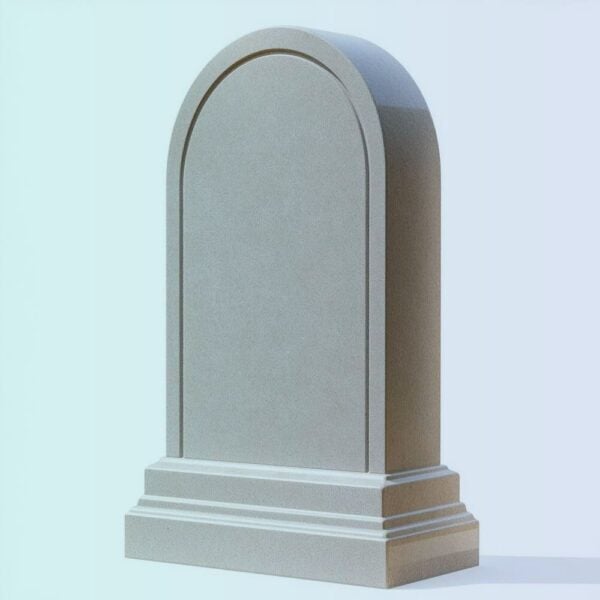
The first is the cross as engraving: a conventional monument – upright, slant, bevel, or flat – carrying a cross cut, etched, or carved in relief on its face. This is the majority of what cemeteries hold, it satisfies nearly every regulation ever written, and it leaves the rest of the stone free for names, dates, verses, and portraits. The cross shares the face; it doesn’t rule it.
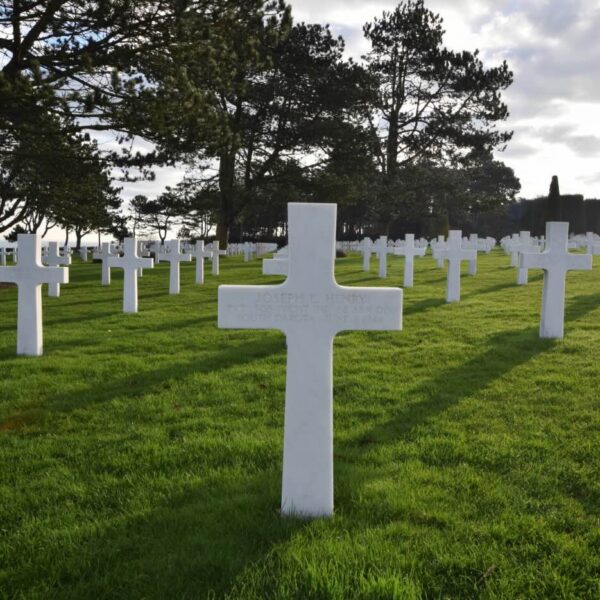
The second is the cross as architecture: the monument itself shaped as a cross, cut from a single granite block or built as a cross rising from a base and tablet. These stand unmistakably. Nobody walks past a six-foot granite cross wondering what the family believed. They cost more, they demand cemetery approval for height, and they carry less inscription space – trade-offs families accept gladly when the statement matters more than the surface area.
Both are true answers. The rest of this article sorts out which one is yours.
Cross on Headstone Engraving and Where It Sits
For the engraved route, placement carries meaning, and there are really four positions in the tradition. A cross on headstone faces most often sits top center, crowning the name – the default of American memorial design for a century and the composition the eye expects. Corner placement, upper left or right, lets the cross preside without dominating, common when a portrait takes the center. The full-face cross runs nearly the height of the stone with the inscription laid inside or beside it, a bold layout that suits uprights with a single name. And the background cross – lightly frosted or shadow-etched behind the lettering – is the quietest version, visible when light rakes the stone in morning and evening, which some families find the truest of all.
Depth is the other lever. A shallow etched cross whispers. A deep V-cut cross with beveled arms throws shadow and reads from the road. Relief carving, where the stone around the cross is cut away so the symbol rises, is the most labor and the most presence. Our engravers do all three, and the 3D preview on every product page shows the difference honestly before anyone commits.
Cross Designs for Headstones Across Faiths and Families
The word cross holds more variety than one shape. Cross designs for headstones range across the Latin cross, plain and eternal, still the most requested mark we cut. The Orthodox three-bar cross with its slanted footrest, essential on Russian, Ukrainian, Serbian, and Greek family monuments, which our shops produce steadily and letter in Cyrillic when asked. The crucifix bearing the corpus for Catholic families, often paired with a rosary draped in carved relief across a corner. The budded cross with trefoil ends, beloved in Methodist and Baptist country. The Cross of Lorraine, the Maltese cross on firefighter stones, the plain and rugged version families call the old rugged cross after the hymn, usually carved as rough-hewn timber with grain and nail marks in the granite.
And the decorated crosses: ivy-wrapped for endurance, rose-wrapped for love, draped with a carved cloth in the old mourning style, backed by sunrise rays, standing on the trinity mound of three steps for faith, hope, and charity. Families mix these traditions freely now. A recent Houston monument carried an old rugged cross with a Vietnam service ribbon at its base – two vocabularies, one man, no contradiction.
Celtic Cross Headstone History Worth Knowing Before You Buy One
The ringed cross deserves its own chapters, because families choose it for reasons a thousand years deep. The Celtic cross headstone descends from the great standing high crosses of early medieval Ireland and Scotland – stone monuments where a circle joins the four arms, carved edge to edge with interlaced knotwork, spirals, and scripture scenes for congregations who couldn’t read. Monasterboice, Iona, Clonmacnoise: the ancestors of every ringed cross in every American cemetery stand in those places still, some of them twelve centuries old and counting.
What the ring means has several tellings – a halo, eternity without beginning or end, older sun symbolism baptized into new faith – and the honest answer is that all the tellings travel together now. What’s certain is what the form became: the single most recognizable emblem of Irish and Scottish heritage in stone. When immigration carried those families to Pennsylvania coal country, Chicago, and the mill towns of the Carolinas, the ringed cross came along, and American cemeteries from Essington to Lemont hold rows of them dated to the 1880s and 1890s, knotwork softened by weather but holding.
Choosing one today is rarely just a design decision. It’s usually a family saying where it came from, in a material that will keep saying it.
Celtic Cross Headstones We Build and How the Knotwork Gets There
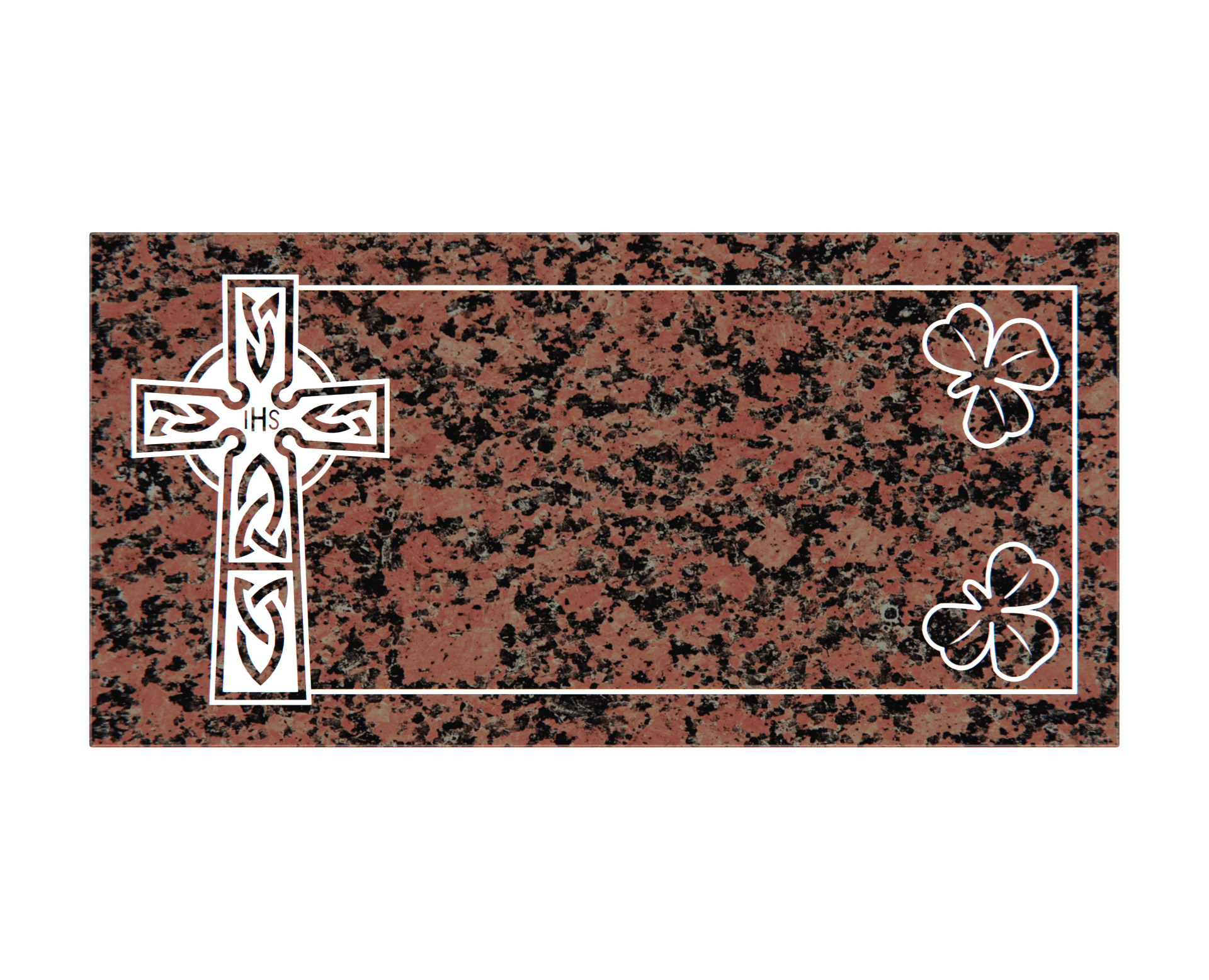
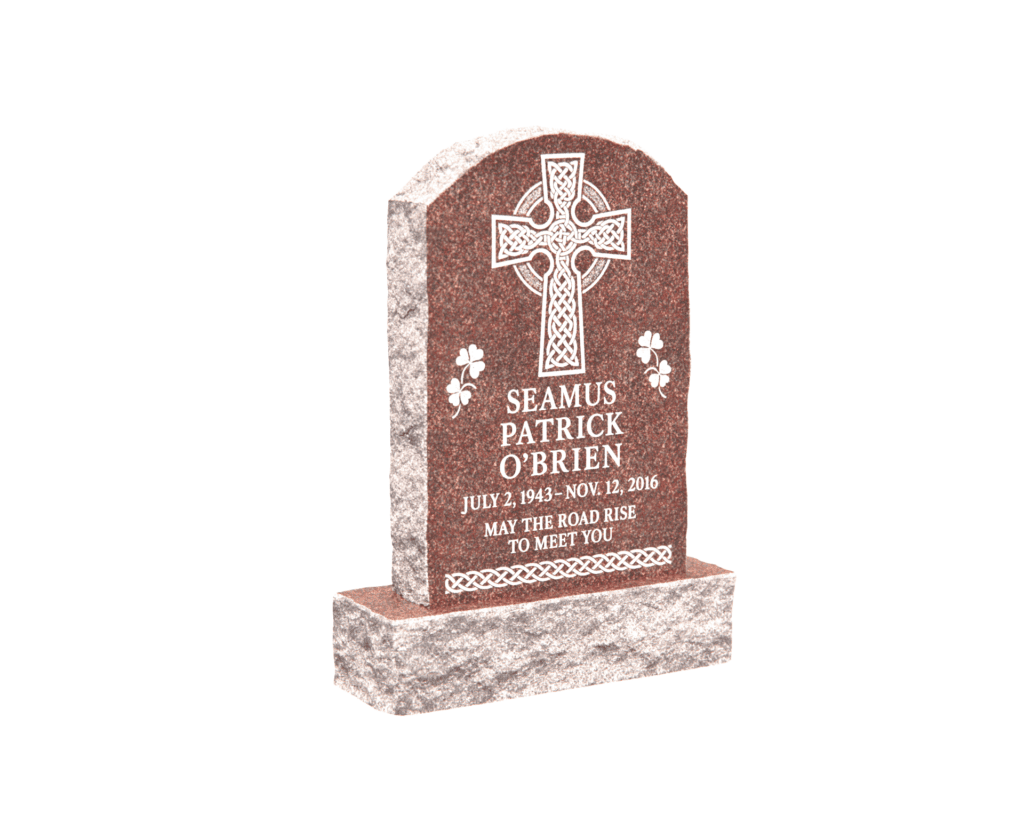
Modern celtic cross headstones from our production come two ways, echoing the fork from earlier. The engraved version places a ringed cross with knotwork on a conventional upright or slant – full heritage statement, standard monument logistics, friendly price. The monumental version is the true shaped cross: shaft, arms, ring, and base cut in granite, from four-foot family pieces to the towering forms that anchor a plot.
The knotwork is where craft shows. Authentic interlace has rules – bands weave alternately over and under, without breaks – and our designers work from traditional patterns rather than clip art, adapting Trinity knots, endless plaits, and spiral bosses to the proportions of each stone. Deep-cut knotwork on the shaped crosses is carved to hold shadow so the pattern reads at distance; etched knotwork on flat faces rewards the close visit. Families often add a name in the base panel, a clan motto, a verse from the old country, or a harp or thistle worked into the interlace. One celtic cross headstone we finished for a Tukwila family carried knotwork their daughter traced from a photograph of a great-grandmother’s grave in County Mayo. The pattern crossed an ocean and 130 years, and now it stands in Washington state, weathering at its own pace.
Black Granite Cross Headstone Options
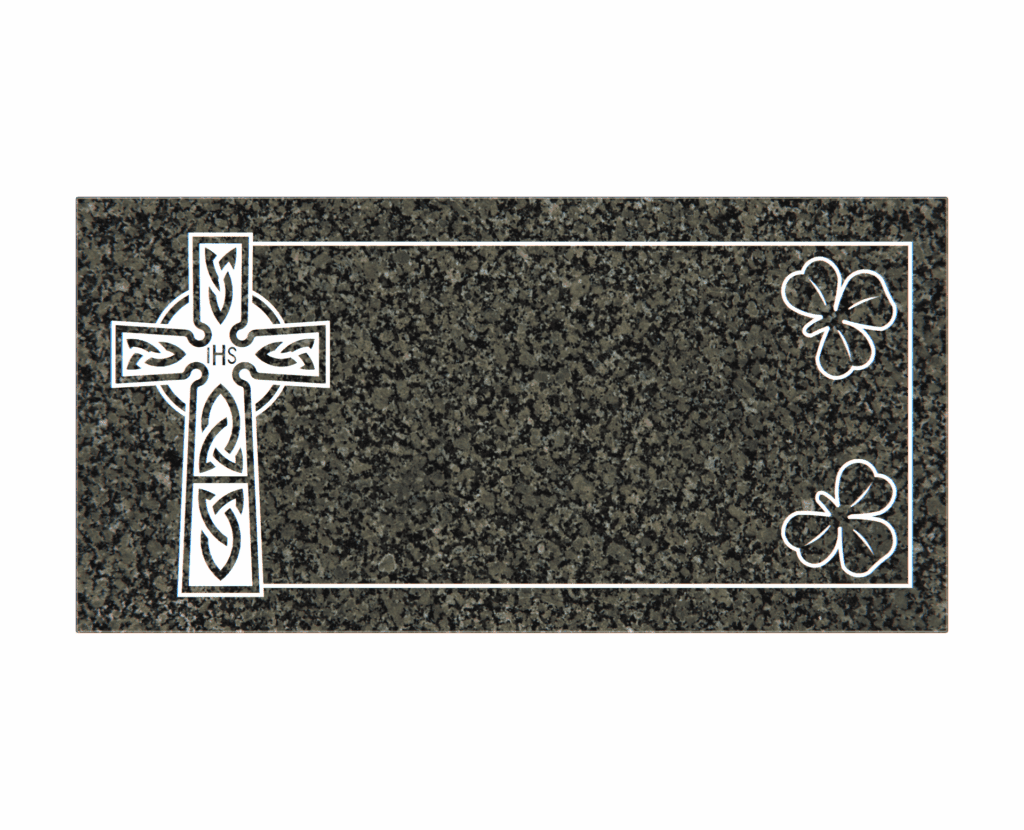
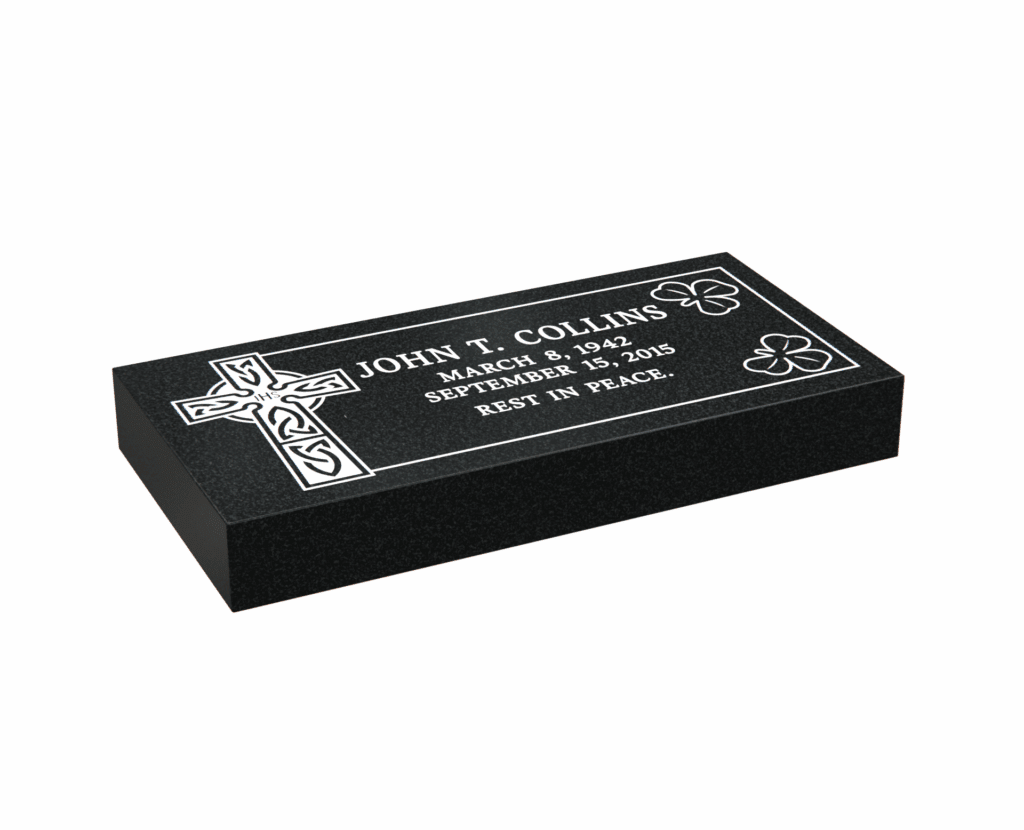
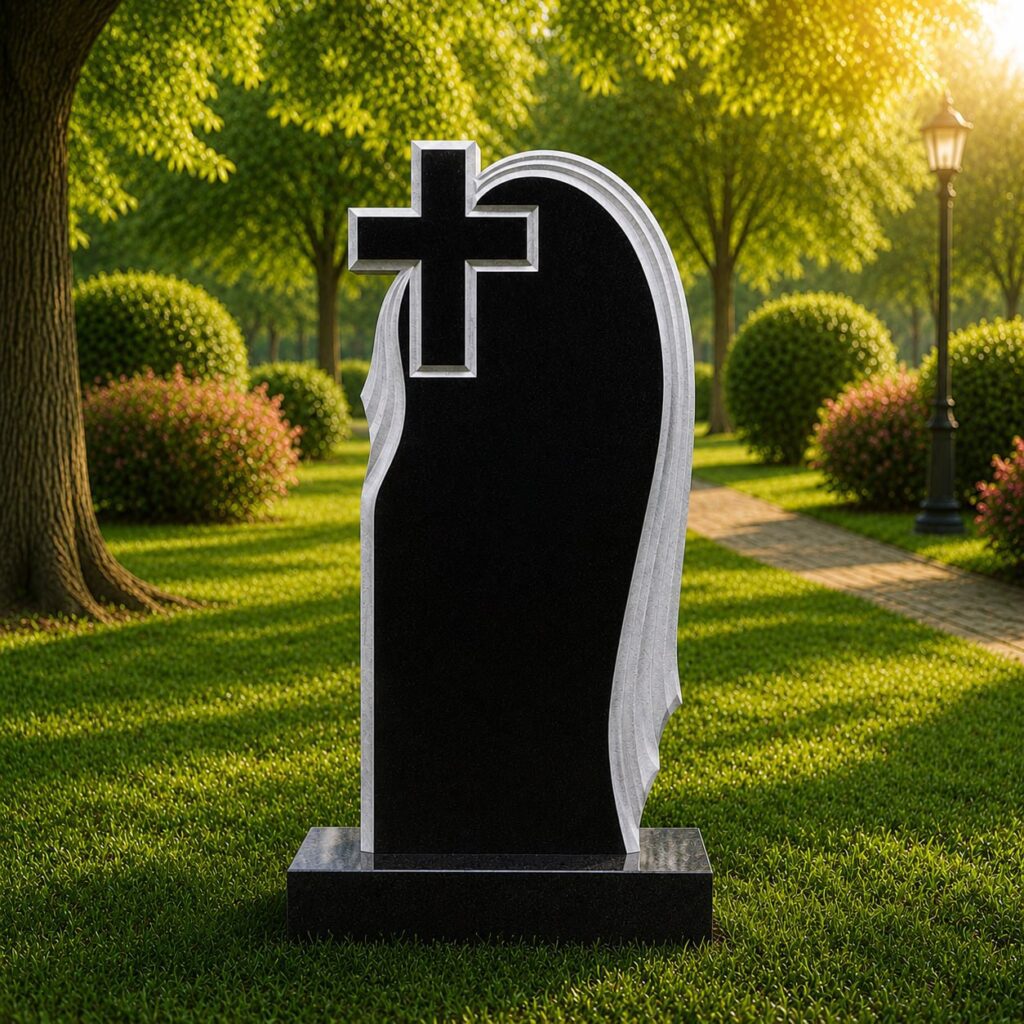
Color changes the character of a cross completely, and black is worth singling out. A black granite cross headstone offers the sharpest contrast in the trade: frosted or etched crosses glow pale against the mirror polish, fine knotwork stays crisp at sizes gray granite would swallow, and laser etching allows a cross to share the face with a portrait in photographic detail – Christ at Gethsemane behind a grandmother’s name, rendered like a plate from an old family Bible.
Shaped crosses in black are rarer and striking, the polish running the full silhouette so the monument reads almost as sculpture. Jet Black and the deep Indian blacks we stock take this best. The practical note: black shows water spots and pollen more than gray between cleanings, a maintenance honesty we offer every family, and none of them has ever changed their mind because of it.
Granite Cross Headstone Shapes in the Catalog
The shaped-cross family itself has branches. A granite cross headstone in the classic Latin proportion – the plain standing cross on a two-tier base – is the form most cemeteries know and approve without discussion. The cross-and-heart combination joins the two shapes, the cross rising behind or beside a heart tablet holding the inscription, a favorite for companion memorials. Cross-topped uprights keep a conventional tablet for the inscription and crown it with a carved dimensional cross, a middle path with generous lettering space. The rugged tree cross, carved as timber, suits families who loved the hymn and the woods in equal measure. And the Celtic forms already described crown the range.
Sizes run from garden-scale crosses under three feet to monuments over six, and pricing follows cut complexity more than height alone – a plain Latin cross is honest work, a fully knotted Celtic shaft is many days of it. Current storewide pricing carries the 35% full-payment discount across all of them, with the same 35% for veterans and first responders.
Granite Cross Headstones Compared With Marble and Bronze
Material questions come up in every consultation, so here is the plain comparison. Granite cross headstones hold detail essentially forever; the stone’s hardness is why century-old knotwork survives at all. Marble, the material of the historic high crosses’ American imitations, carves like a dream and weathers like one too – the sugaring and softening visible on 1890s marble crosses in any Northeastern cemetery is the argument, written in stone, for why the industry moved to granite. Bronze crosses and cross-decorated bronze markers hold up well and suit bronze-only memorial parks, though they live flat; the standing cross belongs to stone. For a headstone with cross work meant to outlast every name that will ever visit it, granite is the answer we give, because it’s the answer the cemeteries themselves display.
Cross Headstones for Graves in Regulated Cemeteries
Rules, briefly, because they bite hardest in this category. Cross headstones for graves face three recurring restrictions, and headstones with crosses in shaped form meet them most often. Height caps – many grounds limit uprights to four feet or so, which decides between a monumental cross and a cross-topped tablet before taste ever enters. Flat-only sections, common in memorial parks from Orlando to Sacramento, which convert the cross to engraving by necessity – and a deep-cut cross on polished black flat granite loses less presence than families fear. And religious-section rules, where some cemeteries reserve certain emblems or require design review.
We check the specific cemetery’s regulations before production on every order, without being asked. Our local teams around Edmond, Enid, Galloway, Roseland, Laguna Woods, Hesperia, Allen, and Dickinson know most of their regions’ grounds from years of installations, and when a family’s chosen design and cemetery disagree, we redesign on paper – never at the gate.
Cross Headstone Engraving Designs You Can Stand Next to Before You Order
The last stretch is the easy one. Every cross headstone engraving designs decision – shape, placement, depth, knotwork, granite color, font – can be configured directly on the product pages at memorystones.us, rendered in 3D as you build it, then projected at true scale through the AR preview, so a six-foot Celtic monument can stand in your yard or on the plot itself through a phone screen before a single saw starts. A free professional design proof with two revisions follows, and nothing is produced until the family approves it.
The commercial frame stays as simple as ever: 35% off with full payment storewide, matching discounts for veterans and first responders, 0% in-house financing to 12 months, extended plans to 24, pre-need arrangements to 36 months at 0%, free nationwide shipping, a 10% price match on comparable quotes, and a lifetime warranty on the work. Showrooms in Sacramento, Los Angeles, Laguna Woods, Hesperia, Houston, Allen, Dickinson, Edmond, Tulsa, Enid, Plainfield, Lemont, Galloway, Essington, Tukwila, Roseland, Orlando, and Spartanburg keep shaped and engraved cross samples on the floor, and families across New York, North Carolina, Kansas, and Arkansas complete everything remotely. Come trace the knotwork with a finger if you can. It answers something screens don’t.


 SUMMER SALE - 35% OFF everything with full payment
 10% OFF on installment plans
